
Betting exchange lay betting
How betting exchange lay betting works
A betting exchange lets users back and lay outcomes against each other. Lay betting on an exchange gives more flexibility than a bookmaker, but it also makes liability, liquidity, matching, and price discipline essential.
Direct answers
- What is a betting exchange?
- A betting exchange is a marketplace where users can back and lay outcomes against each other rather than only betting with a bookmaker.
- How does lay betting work on an exchange?
- One user backs a selection to win and another user lays that selection not to win. The exchange matches both sides where price and money are available.
- Why does liquidity matter?
- Liquidity matters because a displayed lay price is useful only if enough money is available to match the intended stake.
- Does Lay Picks send exchange orders?
- No. Lay Picks uses exchange data read-only for odds context and does not place or submit bets.
Exchange basics
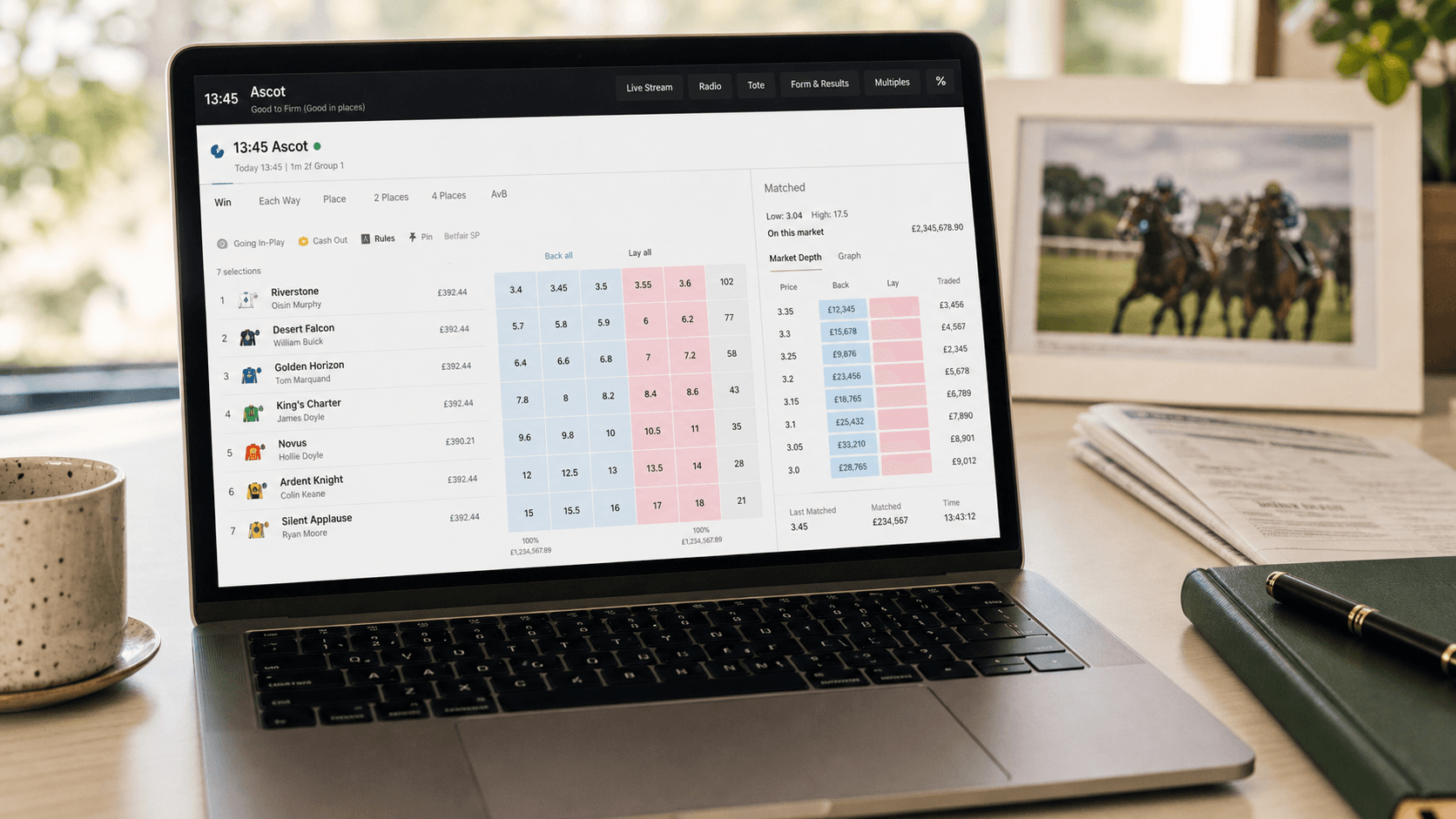
A betting exchange is a marketplace. One user can back a horse to win, while another user can lay the same horse not to win. The exchange matches those positions where price and available money line up.
This is different from a traditional bookmaker because users can act on either side of the market.
How lay prices get matched
A lay price on screen is not always the same as a guaranteed matched bet. There must be enough available money at that price, and the market can move before a user acts.
That is why responsible lay research should include current price, available liquidity, and a willingness to skip if the market no longer fits the plan.
Example: displayed price versus usable price
A horse may show 6.0 to lay, but if only a small amount is available at that price, a larger fixed-price order may be only partially matched, with the rest remaining unmatched. The visible price is only useful when the available money supports the intended stake.
That can change the decision. A runner that looked acceptable at 6.0 may become too risky if the practical matched price is closer to 8.0 or 9.0 because the liability rises with the odds.
Liquidity and stale prices
Thin liquidity can make a lay look better than it really is. If only a small amount is available at a price, the rest may remain unmatched. Accepting a higher lay price to obtain a match would increase liability.
Stale prices are another risk. A race can change quickly after non-runners, public support, going updates, or market moves.
Commission and result tracking
Betting exchanges often charge commission on winning bets. That means the gross result and net result can differ.
A sensible tracker should account for commission, liability, stake, and current bank rather than focusing only on whether the latest lay won or lost.
Example: why tracking exchange context matters
Two users can follow the same research note and still end up with different outcomes if one gets matched at a better price, one accepts a stale price, or one uses a larger stake relative to bank size.
That is why exchange education belongs beside results education. Public results show what happened to the research record, while a personal tracker should record the user’s own matched odds, commission, liability, and notes.
Lay Picks and exchange data
Lay Picks can use exchange odds context where configured, but integrations remain read-only. The product does not place bets, submit orders, or control a user's exchange account.
Users stay responsible for checking the final exchange market and making any manual decision themselves.
Responsible use
Exchange betting can move quickly. A disciplined user should know the liability, check the available price, and be prepared to skip if the evidence or liquidity changes.
Lay betting involves risk. You can lose more than your stake because liability depends on the lay odds.
What is a betting exchange?
A betting exchange is a marketplace where users can back or lay outcomes against each other rather than only betting with a bookmaker.
Why does exchange liquidity matter?
Liquidity matters because a displayed price is useful only if there is enough money available to match the intended stake.
Does Lay Picks place exchange bets?
No. Lay Picks exchange integrations remain read-only. Users make their own manual decisions outside Lay Picks.
Related guides
Keep the topic connected to the next practical step, so readers can move from one concept to the full responsible lay betting workflow.
Betfair lay tips and market checks
Apply matching, liquidity, commission and liability checks to a manual Betfair lay decision.
Read guideBetfair vs Smarkets vs Matchbook
Compare the main exchange choices for horse racing lay betting, including liquidity, commission, and market depth.
Read guideBest exchange for horse lays
Use a practical checklist for exchange liquidity, lay odds, commission, matching, and manual control.
Read guideLay betting glossary
Check the terms behind lay odds, liquidity, matched bets, commission, and liability.
Read guideBacking vs laying
Review the basic exchange difference before getting deeper into markets.
Read guideLiability calculator
Try the simple calculator to see how exchange odds change downside exposure.
Read guideResponsible staking tracker
Track stake, matched odds, liability, result, notes, and bank movement after each manual decision.
Read guideResults methodology
See how exchange-led lay research is counted once a public recommendation settles.
Read guideBest reading path
Follow the lay betting learning route
Move through the core guides in order: basics, liability, exchange mechanics, strategy, racecourse context, and transparent results methodology.
Step 1
What is lay betting?
Start with the basic exchange concept: opposing a selection rather than backing it to win.
Open guideStep 2
Liability
Understand the amount at risk before looking at tips, strike rates, or staking.
Open guideStep 3
Exchange guide
Learn how lay odds, liquidity, matching, and commission affect a usable price.
Current stepStep 4
Strategy
Turn runner vulnerability, public checks, price, and skip discipline into a process.
Open guideStep 5
Racecourse guides
Add course shape, draw, pace, going, and distance context before trusting a lay angle.
Open guideStep 6
Results methodology
Read how settled public results are counted before judging any performance record.
Open guideKeep learning
Leave a comment
Have a question, correction, or suggestion for this guide? Send it to the Lay Picks team and mention the page title so we can review it properly.
Email a commentRead another guide
See how exchange odds turn into the amount at risk before making a manual lay decision.
Lay betting liabilityLay Picks is for informed adults who want a clearer research routine. It is research and tracking software only, never automatic betting. You stay responsible for every manual decision. 18+ only. Read the risk disclaimer.